
The Unusual Story Behind Michigan’s Lost Peninsula
Would you like to save this full guide?
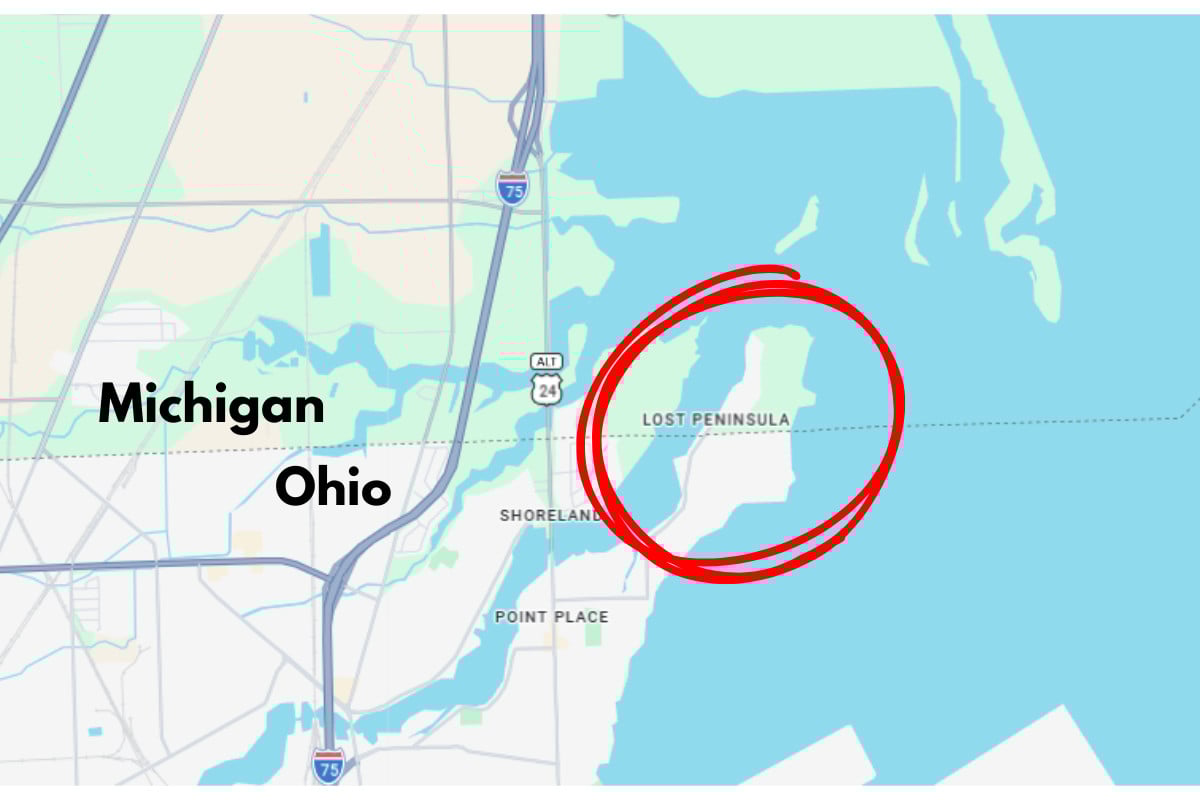
Michigan is a state known for its peninsulas, but there is one so far under the average person’s radar, its name even says so: The Lost Peninsula. This peculiar piece of land jutting into Lake Erie, though technically part of Erie Township in Monroe County, is completely cut off from any Michigan neighbors.
Only by traveling through Ohio, whether by boat or by car, can you reach the Lost Peninsula of Michigan.
The peninsula became “lost” after a border dispute between Michigan and Ohio in the early days of statehood. The community has found itself in a strange position ever since.
Residents commute over state lines for work, have mailing addresses in Ohio but pay taxes to Michigan, receive a mix of services provided by the two states, and bus their kids through Toledo to get to school in Erie, Michigan. It all came about because of a great rivalry.
How to Get to the Lost Peninsula
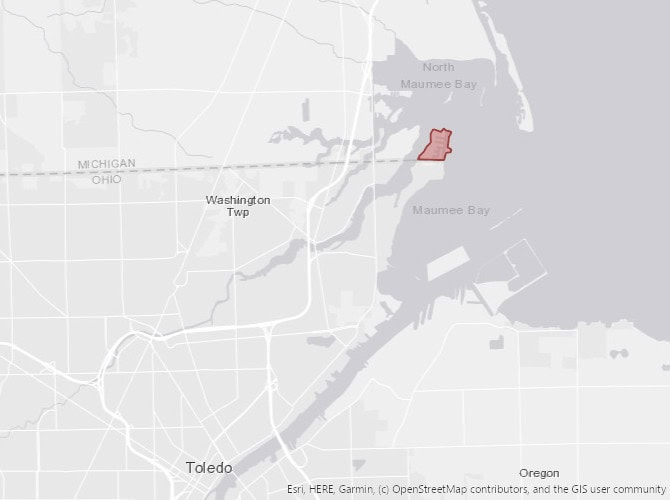
Getting to the Lost Peninsula from mainland Michigan is quick and easy, despite the necessary state border crossing. From I-75 South, take exit 2 for Summit Street/Alternate US-24 and continue straight into Ohio. Then, turn left on 131st Street and turn left again on Edgewater Drive, which will take you to the Lost Peninsula.
The Lost Peninsula Today
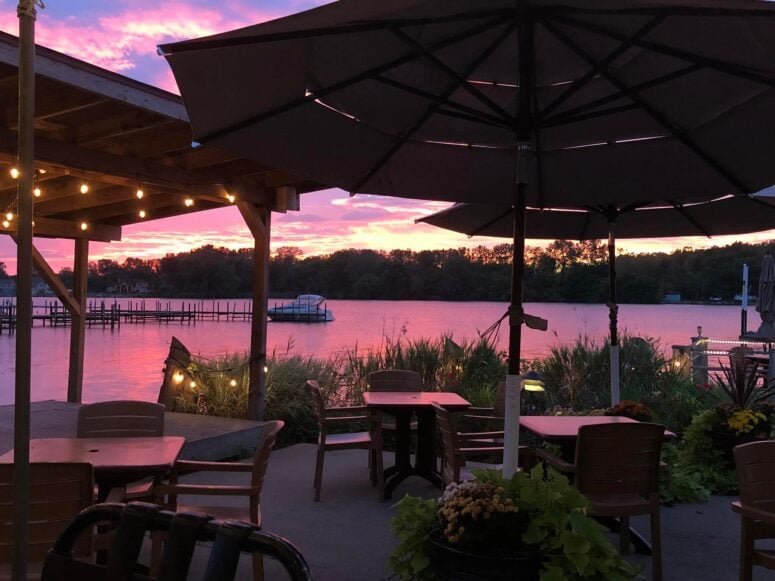
Today, a marina and private residences make up most of the Lost Peninsula. However, it’s still worth a trip. Webber’s Waterfront Restaurant is open from Spring to Fall, offering fresh seafood and cocktails with views of the Ottawa River.
Right next to the parking lot is the state boundary marker, along with a 1965 plaque. Visitors can get a photo with one foot in Michigan and one in Ohio before heading to Webber’s for a bite to eat.
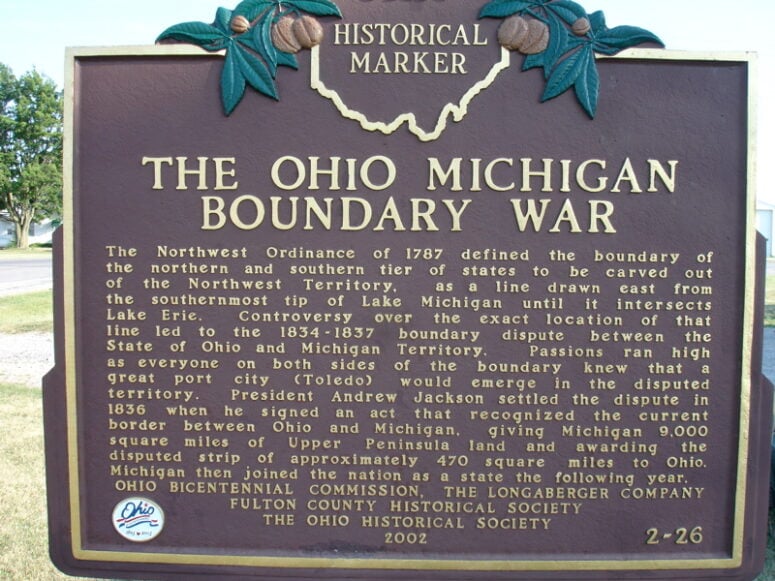
Michigan vs. Ohio Rivalry Origin Story: The Toledo War
One thing Michiganders and Ohioans have in common is a mutual (mostly) good-natured disdain for each other. Anyone who grew up in a household loyal to the University of Michigan or Ohio State will feel this deeply. Some believe the rivalry goes all the way back to a conflict known as the Toledo War.
It all started with a fight over Toledo.
Both Ohio and Michigan were carved out of the Northwest Territory in the 1800s. Ohio became a state first, and in 1835, as Michigan was working out the details, the two states’ exact borders became controversial.
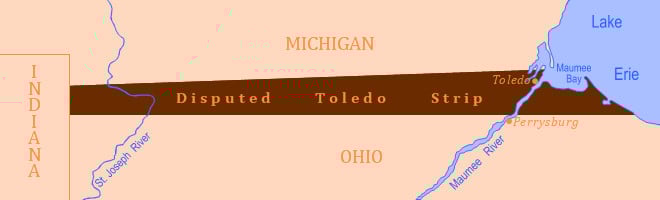
Michigan history buffs will know the Toledo War was the dispute over the “Toledo strip” – a 468 square mile section of land along Michigan’s southern border. Both states wanted Toledo’s access to the Maumee and Ottawa Rivers and Lake Erie’s Maumee Bay. Neither state intended to back off on its claim to the area.
Bad maps made a messy situation worse.
The source of the dispute seems to be poor cartography. The boundary was supposed to be a straight east-west line from the southern end of Lake Michigan.
Today, we know that the line would run south of Lake Erie, and therefore Toledo would be part of Michigan. But the maps weren’t exactly accurate in early America, resulting in confusion and inevitably, a dispute.
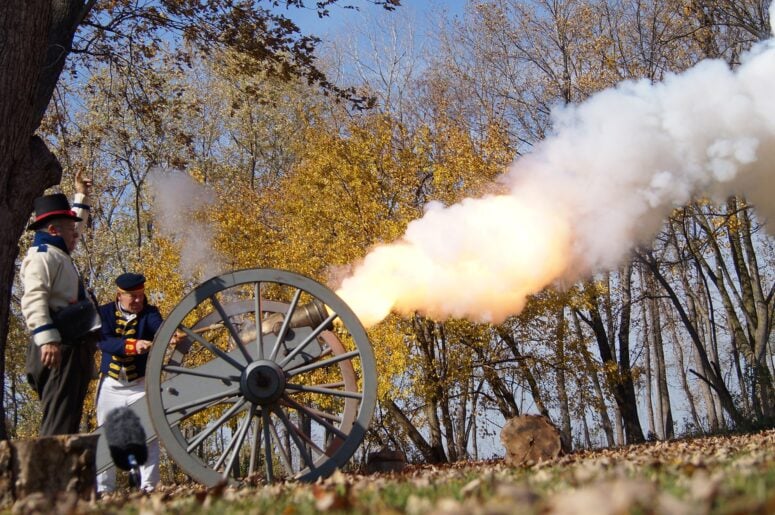
Fortunately, the only shots fired during the “war” were into the air, and only one person was injured.
Michigan “lost” the war… or did it?
The war ended in 1836 when Congress brokered a compromise: Ohio would get the Toledo strip, and Michigan would get the Western Upper Peninsula. (At the time, Michigan was considered the losing side, but now we know better.) For more details, check out The Toledo War: The First Michigan-Ohio Rivalry by Don Faber.
The compromise created a forgotten corner of Michigan.
The resolution of the Toledo War gave Michigan a straight line border north of Toledo without regard to land practicalities, cutting off about 240 acres of land which would henceforth be known as The Lost Peninsula.
Trimalchio on Wikimedia Commons
Ohio Still Really Wants the Lost Peninsula
Though the Toledo War was officially settled in 1836, the Lost Peninsula has remained contested ground. Here’s a nowhere-near-exhaustive timeline of events:
1915: Official Boundaries Set
Michigan and Ohio agree to an official boundary survey, completed in October. Michigan Governor Woodbridge Ferris and Ohio Governor Frank Willis stand in their respective states and shake hands over the Lost Peninsula’s boundary marker, post 70.
1953: Ohio Proposes a Lost Peninsula Park
The Detroit News reports that officials in Toledo are considering asking Michigan to cede the peninsula for the development of a park. The Michigan House representative from Monroe County is open to the idea, but the Erie Township supervisor says, “over my dead body.”
1960: Ohio Wants to Annex the Peninsula
A Toledo City Councilman brings up annexation, which again goes nowhere. Marina construction is underway.
1965: Ohio Tries to Take Over the Peninsula’s Marina
The states bicker over offshore borders, which were not settled at the conclusion of the Toledo War. Ohio tries to take over the peninsula’s marina, but Michigan Attorney General Frank Kelly says, “As far as Michigan is concerned, it will never cede an inch of Lost Peninsula lands to Ohio.”
Ohio is not discouraged, so Kelly doubles down, saying, “I might remind our neighbor that Michigan has a naval force.” Michigan’s naval force consists of one retired rear admiral, but Ohio decides not to call the bluff.
1976: Ohio Approves Purchase of Peninsula, But It’s Not For Sale
The Toledo City Council approves the purchase of the peninsula for a public park. However, the land is not for sale.
1985: Ohio Proposes a Sports Bet; Michigan Wins the Game
The rivalry comes full circle as Toledo attempts to place ownership of the peninsula on the outcome of the Michigan-Ohio State football game. Michigan officials declined to make the wager, noting that they had nothing to gain. University of Michigan wins, 27-17.
This Little Peninsula Has Stories to Tell
Over the years, plenty has happened in the land now known as the Lost Peninsula.
The Wyandotte Nation first lived on this land.
Before the citizens of the young United States fought over the land, the Wyandotte Nation settled in Southeast Michigan and Northeast Ohio, including the area of the Lost Peninsula. They were involved in various conflicts in the area, often supporting French or British forces throughout the 1700s and 1800s.
However, as state lines were drawn, Indigenous people were drawn out. The Wyandotte were forced to move to Kansas in the 1840s.
The Lost Peninsula becomes a prime spot for smugglers during Prohibition.
Over time, new residents moved to the peninsula, drawn by its seclusion and lake views. These were also attractive qualities for smugglers. Michigan banned alcohol in 1917, and rum-running became a booming business.
Because the Lost Peninsula was not easily accessible by Michigan police, and Ohio police had no jurisdiction, it was a prime spot for border-crossing with the banned substance.
Webber’s Glassless Tavern, the peninsula’s first restaurant, opens its doors.
Prohibition ended in 1933, which was the same year John and Alice Webbers opened a drinking establishment on the Lost Peninsula. Initially, folks would park their cars, get their beverages, and hang around outside to drink.
In 1934, John and Alice opened a kitchen serving seafood, and Webber’s Glassless Tavern, which served drinks in paper cups, was in business. The restaurant stayed in the family until 1980, when another local family, the Merrymans, took over.
Now, the restaurant is known as Webber’s Waterfront Restaurant.
The Palm Sunday Tornado tears apart the peninsula.
Tragedy came to the Lost Peninsula in 1965. On the evening of April 11, Palm Sunday, an F-4 tornado formed in Toledo and roared across the Lost Peninsula. It was part of an intense, three-day period of storms across the central United States, which included 55 tornadoes in all.
The Lost Peninsula tornado was 200 yards wide and traveled 5.6 miles, making it smaller and shorter than most tornadoes of the outbreak. But it was just as destructive. Eighteen people died, including two Peninsula residents.
The tornado destroyed most homes in its path. The Detroit Free Press described some of the aftermath: “A 35-foot cabin cruiser, lifted from its cradle, crashed through the roof of a home, landing on the first floor.”
The Detroit News reported that Webber’s Glassless Tavern was nearly a total wreck. When the storm came through, 15 employees and customers were in the building, but fortunately, none were injured. Bob Webbers told the reporter they would rebuild, saying, “We’ve been operating here since the early 1930s and intend to remain for a long time more.”
Things to Do Near the Lost Peninsula
If you make the journey to Michigan’s Lost Peninsula, there’s plenty more to do nearby:
- River Raisin National Battlefield Park is the only national park dedicated to the War of 1812. It commemorates the 1813 Battle of Frenchtown, which was the deadliest conflict fought in Michigan during the War.
- Stop by the visitors center to view the exhibits, then take a driving tour, or hike or bike along the Heritage Trail.
- Enjoy the mile-long sandy shore of Sterling State Park, the only Michigan State park on Lake Erie, which offers a range of outdoor activities.
- Erie Orchards and Cider Mill is a rare orchard dedicated to minimizing chemicals on their produce. Their seasonal offerings include an animal farm, play structures, and apple picking.
Check out more things to do in Monroe County.