

Where & When to Watch the 2026 Perseid Meteor Shower in Michigan
Would you like to save this full guide?
Every year, the Perseid meteor shower is a must-see for starry sky enthusiasts across the globe. And this week, the annual star show is scheduled to peak in Michigan!
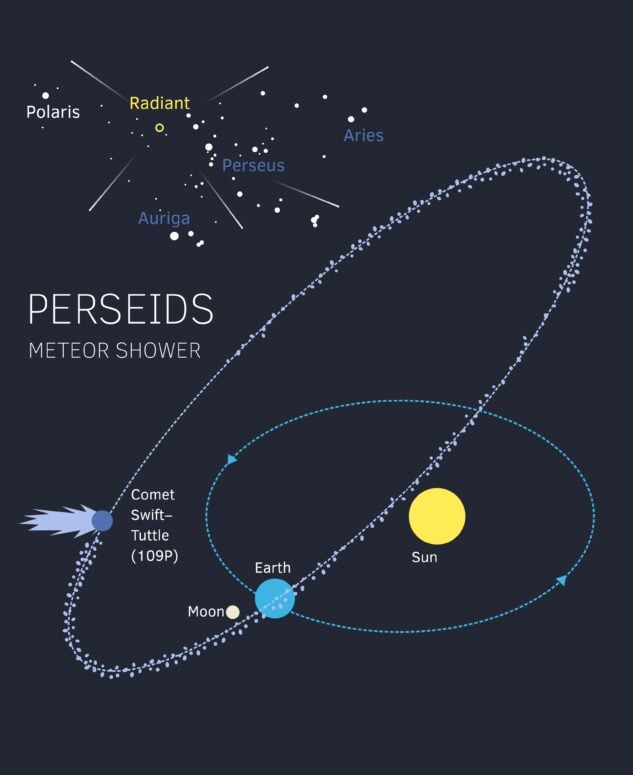
What You Need to Know About the 2026 Perseids Meteor Shower
The Perseids meteor shower is an annual event that happens every year around mid-August.
As Earth orbits around the sun, it passes through a cloud of debris left behind by Comet 109P/Swift-Tuttle (aka Comet Swift-Tuttle). When these tiny pieces of rock and dust enter Earth’s atmosphere, they burn up and create bright streaks of light in the sky.
The best time to see the Perseids is during their peak, which will occur between midnight and 5 am the evening of Wednesday, August 12, into Thursday, August 13, 2026. During this time, you might be able to see up to 50-100 meteors per hour!
In 2026, the peak of the meteor shower occurs during a New Moon – the phase when the moon is the darkest. This means the meteors will appear even brighter in the sky.
Fun Fact: The Perseids are named after the constellation Perseus because that’s where the shooting stars seem to come from. Astronomers call this point the “radiant.” The best time to look for shooting stars is when Perseus is high in the sky.
Keep reading to learn more about meteor showers and find out where to watch the Perseids meteor shower in Michigan this week…

Where to See the 2026 Perseid Meteor Shower in Michigan
Michigan is fortunate to have both dark sky preserves and parks that provide stunning celestial views. These locations are specially chosen for their ability to limit artificial light, making them perfect for nighttime viewing. Additionally, the Upper Peninsula offers over 15,000 square miles of places for stargazing in Michigan.
When looking for the perfect spot to watch shooting stars, constellations, or the Northern Lights in Michigan, remember these tips:
- The further away from a town, the better.
- Check that the moon isn’t full.
- Charge your camera for long-exposure photos.
While any dark place with a clear view of the sky will work, these dark sky preserves are especially perfect for viewing meteor showers – and you may find some fellow starry sky enthusiasts to enjoy the show with!
Michigan Dark Sky Preserves
- Lake Hudson Recreation Area (Lenawee County)
- Negwegon State Park (Alcona County)
- Port Crescent State Park (Huron County)
- Rockport Recreation Area (Presque Isle County)
- Thompson’s Harbor State Park (Presque Isle County)
- Wilderness State Park (Emmet County)
International Dark Sky Preserves in Michigan
- Headlands Dark Sky Park (Emmet County)
- Keweenaw Dark Sky Park (Keweenaw County)
- Dr. T.K. Lawless Park (Cass County)

About Meteors & Meteor Showers
Meteoroids are small pieces of space debris that range in size from tiny specks of dust to large fragments of asteroids or comets. When a meteoroid enters Earth’s atmosphere, it creates a bright streak of light in the sky called a meteor.
People used to think that meteors were just a part of the Earth’s atmosphere, but we now know that they come from space. If any pieces of the meteoroid survive and reach the ground, they are called meteorites. The study of meteors and other atmospheric effects led to the science of meteorology.
Meteor showers are events that happen when Earth passes through a stream of dust and debris left behind by a comet. Most meteor showers come from comets, but one major shower comes from an asteroid. When Earth passes through the stream, the dust and debris burn up in our atmosphere and create shooting stars.
The “shooting stars” all seem to come from the same point in the sky, which is called the radiant point. This is because the particles are all traveling in parallel paths at the same velocity. The radiant point is named after the constellation it appears to be coming from. For example, the Perseids meteor shower seems to come from the constellation Perseus.
Meteor shower rates can vary a lot, with some showers producing only a few meteors per hour and others producing up to 100 per hour. The number of meteors seen will increase as Earth approaches the densest part of the stream and then decrease as Earth leaves. The peak of a meteor shower can last for a few hours or a few days.
There are also minor meteor showers, which are harder to detect because they produce fewer shooting stars. They usually only yield about 1-5 meteors per hour at their peak. It takes a lot of observing experience to recognize and classify minor shower meteors.

How to Watch a Meteor Shower
To observe a meteor shower, you’ll need to be familiar with the night sky and use star charts to locate constellations. It’s best to plan your observation session as close to the time of shower maximum as possible and to observe from a dark location away from city lights.
Once you’re at the observation site, give your eyes time to adjust to the dark (which can take over an hour) and use dim red lights sparingly. Most observers lie down in a lawn chair or sleeping bag and look about 45 degrees above the horizon in the direction of the shower radiant.
Meteor showers are best seen when the radiant is high in the sky, and meteors near the horizon will be dimmer and harder to notice. Patience is key when observing meteor showers, as they usually produce a steady show rather than a spectacular display. Each shooting star is like a natural fireworks display, and you never know when the next one will appear or how bright it will be.
So, if you want to experience this awesome stargazing event, grab a blanket, head outside, and look up at the sky tonight!

FAQs About the 2026 Perseid Meteor Shower in Michigan
Can you see the Perseid meteor shower in Michigan?
Yes, you can see the Perseid meteor shower in Michigan. At least one meteor is expected to appear every minute or so during the shower’s peak between August 12 and 13, 2026.
Where can you see the Perseid meteor shower 2026?
You can see the Perseid meteor shower from anywhere in the world, but the best views are from areas with little light pollution. The Perseid meteor shower will be visible in the Northern Hemisphere.
What time is the Perseid meteor shower in 2026?
The peak activity of the Perseid meteor shower in 2026 will occur between midnight and 5 am the evening of Wednesday, August 12, into Thursday, August 13.
What is the best time to see the Perseid meteor shower?
The best time to see the Perseid meteor shower is during the pre-dawn hours from Wednesday, August 12, into Thursday, August 13. However, you can still see some shooting stars before and after the peak time.